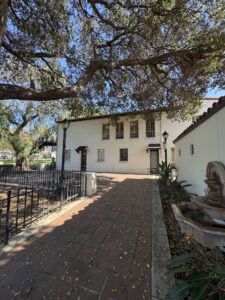
A Century in the Shade: Caring for the Brea Museum’s Old Oak
By Tanner Peterson, ISA Certified Arborist WE-15767A, Peterson’s Tree
Works (Orange County since 1980)
If you came to “An Evening under the Oak” this summer, you already know the museum’s patio oak is the star of the courtyard. A tree that
has likely stood for more than 100 years has lived through Brea’s whole story as a city, which was incorporated in 1917. Here is how an
old oak like this one works, what quietly hurts it, and what keeps it going for another century.
How an old oak is built
– Roots are wide and shallow, not deep. Most of a mature tree’s absorbing roots are in the top foot or two of soil and spread well
past the edge of the canopy (the dripline). That is why what happens on the patio, the lawn, or a nearby trench matters so much more than most people think.
– The root collar (or root flare) is where the trunk widens into the main roots at the soil line. It is meant to stay dry and exposed to
air. Soil, mulch, or constant water piled against it invites rot. – Trees don’t heal; they seal. When a branch is cut or broken, a tree
does not replace damaged wood. It walls it off, a process arborists call compartmentalization. A good pruning cut, made just outside the
branch collar (the slightly swollen ring where a branch joins the trunk) and following the angle of the branch bark ridge, lets the tree
seal the wound fastest. Flush cuts that slice into the collar, and stubs left too long, both leave the door open to decay.
The biggest risk for an old native oak: summer water at the trunk
California’s native oaks evolved with wet winters and bone-dry summers. University of California research and UC IPM guidance are
clear on this: the oak root fungus, Armillaria mellea, lives in many of our soils and becomes active when soil is both warm and moist. In
nature our summer soils dry out, so the fungus stays quiet. When a sprinkler or drip line keeps the base of an oak wet through summer,
warm soil and moisture line up, and the tree can be infected and killed. Crown rot caused by Phytophthora species is linked to the same
wet conditions. UC IPM notes that most Armillaria deaths in California landscapes trace back to excessive irrigation or other stress, not the fungus alone.
What that means for the patio oak:
– Keep the root collar dry, especially from late spring through fall. Point sprinklers away from the trunk.
– Don’t plant thirsty plants (lawn, annual flowers, ivy) under the canopy. A turf-free, mulched zone out toward the dripline is ideal.
– If the tree needs water in a long drought, UC research found deep, occasional watering helped drought-stressed oaks when it was applied
at least about 10 feet from the trunk, in the outer two-thirds of the root zone, never at the trunk.
What else quietly hurts old oaks
– Grade changes. Adding even a few inches of soil over the roots, or scraping soil away, cuts off oxygen or removes the roots that feed the
tree. Decline can take years to show. – Trenching and digging under the canopy for utilities, lighting, or
patio work can sever a large share of the absorbing roots in an afternoon.
– Soil compaction from foot traffic, tables, and vehicles squeezes out the air roots need. Wood chip mulch spread over the root zone (a few
inches deep, pulled back several inches from the trunk) cushions traffic and keeps soil cooler.
– Over-pruning. Old oaks are not hedges. Removing big live limbs or “thinning” the interior heavily (sometimes called lion-tailing, which
leaves foliage only at branch ends) stresses the tree and can trigger clusters of weak epicormic shoots (water sprouts). For a veteran tree,
pruning should be light and purposeful: remove dead wood, hangers (broken limbs caught in the canopy), and clear limbs from roofs and
walkways, using reduction cuts back to a lateral branch rather than heading cuts to a stub. Topping is never appropriate.
Warning signs worth a closer look
Have an ISA Certified Arborist take a look if you notice: – Mushrooms at the base of the trunk or on the roots. Armillaria is
known for clusters of tan to honey-colored mushrooms (“honey mushrooms”) with a ring on the stem, at the base of infected trees.
Some infected trees never produce mushrooms, so their absence is not proof of health. – Yellowing or thinning leaves and dieback at the top of the canopy.
– Bleeding or dark staining on the bark, or bark that is loose or cracking near the soil line.
– Cracks in the trunk or at a branch union (where two stems meet), especially where two upright codominant stems are pressed together
with bark trapped between them (included bark), which makes that union weaker.
– New lean, or soil or pavement lifting on one side of the trunk (root plate heave), which can mean the root system is moving.
– D-shaped exit holes about 4 millimeters (a little over 1/8 inch) wide, mostly in the lower 10 feet of the trunk. These are the calling
card of the goldspotted oak borer, an invasive beetle that prefers mature red-group oaks such as coast live oak and has killed tens of
thousands of oaks in San Diego County. It was confirmed in Orange County at Weir Canyon in 2014, likely carried in by firewood. Never
bring oak firewood in from other counties. Buy it where you burn it.
Stay tuned for our next installation on Brea’s other famous trees
—
Tanner Peterson is an ISA Certified Arborist (WE-15767A) with
Peterson’s Tree Works, an Orange County family tree-care business
since 1980. petersonstreeworks.com/tree-se